

 Get Help Now
National Recovery Month 2026: Recovery Is REAL and Treatment Makes It Possible
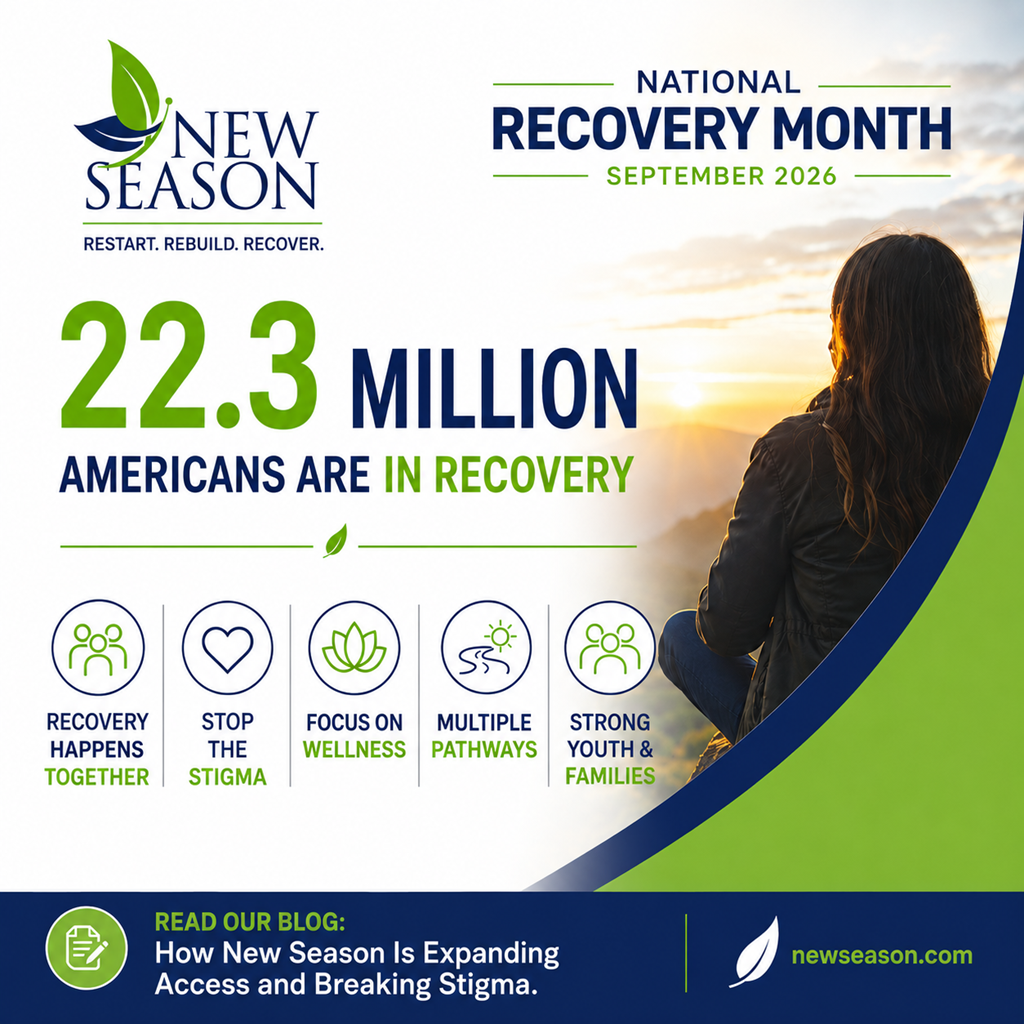
Every September, National Recovery Month celebrates people who are rebuilding their lives after substance use and recognizes the families, communities and professionals who help make recovery possible.
For 2026, the Substance Abuse and Mental Health Services Administration (SAMHSA) is continuing an important message: Recovery is REAL: Restoring Every Aspect of Life. This year’s campaign focuses on five interconnected themes: community and connection, reducing stigma through storytelling, wellness, multiple pathways to recovery, and youth and families.
At New Season Treatment Center, we see what “restoring every aspect of life” can mean every day. For a person living with opioid use disorder (OUD), recovery can mean improved health, greater stability, rebuilding relationships, returning to work, reconnecting with family and finding hope in a future that once felt impossible.
And while there are encouraging signs in America’s fight against the opioid epidemic, the need for evidence-based, compassionate treatment remains urgent.
The Opioid Epidemic Is Changing – but It Is Not Over
There is reason for hope.
According to the Centers for Disease Control and Prevention (CDC), provisional data indicate that approximately 69,973 people died from a drug overdose in the United States in 2025, nearly 14% fewer than in 2024. Opioid-involved overdose deaths declined from an estimated 55,296 in 2024 to 44,564 in 2025. Read the latest CDC overdose data.
That progress matters. But tens of thousands of lives are still being lost, and millions of Americans continue to live with opioid use disorder.
The latest National Survey on Drug Use and Health (NSDUH) estimates that 4 million Americans ages 12 and older had opioid use disorder in 2025. Yet only 15.7% of people with past-year OUD received medications for opioid use disorder. Review the 2025 National Survey on Drug Use and Health.
That treatment gap represents one of the greatest opportunities in the next phase of the opioid epidemic.
“Declining overdose deaths show us that progress is possible, but our work is far from finished. Every person who cannot access treatment, delays treatment or leaves treatment too soon represents an opportunity to do better. Recovery Month reminds us that our responsibility is not simply to make treatment available; it is to make effective treatment accessible, compassionate and sustainable.”
— Jim Shaheen, CEO, New Season Treatment Center
Treatment Works – and Staying in Treatment Matters
Opioid use disorder is a treatable medical condition, not a moral failing.
The CDC reports that medication treatment for OUD is associated with reductions in both overdose risk and overall mortality. FDA-approved medications include methadone, buprenorphine and naltrexone. The CDC also specifically cautions that detoxification without medication is not recommended as a stand-alone treatment for OUD because of the increased risks of returning to opioid use, overdose and death. Learn more from the CDC about evidence-based OUD treatment.
Treatment retention is equally important.
A recent study published in JAMA Network Open examined hundreds of thousands of treatment episodes at opioid treatment programs nationwide. Among the Medicaid population studied, median retention was approximately 61% at 30 days, 42% at 90 days and 28% at six months. Researchers noted that longer treatment duration with medications for OUD is associated with a lower risk of overdose and death. Read the JAMA Network Open study.
New Season separately tracks retention across its own patient population. In 2025, internal New Season data showed median retention rates of 92% at 30 days, 74% at 90 days and 62% at six months. While New Season’s internal methodology differs from the Medicaid claims methodology used in the JAMA study, the results reinforce the importance of designing care around long-term patient engagement. See how New Season is approaching treatment retention.
For New Season, keeping patients connected means recognizing that recovery is not only about medication. It is about the entire person.
Recovery Happens Together
SAMHSA’s first 2026 Recovery Month theme is “Recovery Happens Together.” It recognizes a basic truth: connection can strengthen resilience, hope and long-term recovery.
That philosophy is reflected in New Season’s comprehensive approach to opioid addiction treatment.
In 2025, New Season served 33,469 patients, the highest census in its history at that time, through 90 treatment centers in 20 states. The organization delivered more than 393,000 counseling sessions and 135,000 medical evaluations while expanding telehealth, primary care services and Intensive Outpatient Programs. Telecounseling participation alone increased 49%. Explore New Season’s 2025 Annual Report highlights.
New Season has continued expanding access in 2026, including through new treatment locations and Mobile Medication Units that bring opioid treatment services directly into communities where transportation, geography and other barriers can make consistent care difficult. Learn about New Season’s Mobile Medication Units.
Recovery becomes more achievable when care fits into people’s real lives.
Stopping the Stigma Around Opioid Addiction and Medication
Another major focus of Recovery Month 2026 is reducing stigma through storytelling.
That work is more than a communications campaign. Stigma can become a barrier to treatment.
SAMHSA’s latest national survey found that people who did not receive substance use treatment reported barriers that included believing they should handle the problem themselves and worrying about what other people might think or say if they sought care.
Changing that begins with changing the way we talk about addiction.
A person receiving methadone or buprenorphine is not “replacing one drug with another.” These are evidence-based medications used to treat a chronic medical condition. SAMHSA has specifically emphasized the importance of eliminating stigma surrounding medications used to treat substance use disorders. Learn about medications for opioid use disorder from SAMHSA.
“Stigma becomes dangerous when it keeps someone from walking through the door and asking for help. Our patients deserve the same dignity we would give someone seeking treatment for any other chronic medical condition. The language we use, the way we welcome people and the stories we choose to share can all help create an environment where asking for treatment is viewed as an act of strength.”
— Jessica Matthews, Chief Operating Officer, New Season Treatment Center
New Season’s commitment to stopping stigma also means meeting patients without judgment and recognizing that recovery rarely follows a straight line.
There Is More Than One Path to Recovery
SAMHSA’s Multiple Pathways theme is particularly important in opioid addiction treatment.
There is no single recovery journey that works for every person. Treatment should reflect an individual’s medical history, personal circumstances, goals, support system and stage of recovery.
New Season provides comprehensive outpatient OUD treatment that can include methadone or buprenorphine, counseling, medical care, telehealth, Intensive Outpatient Programs, primary care services and other individualized supports. Explore New Season’s opioid addiction treatment services.
“Opioid use disorder is a chronic medical condition, and our treatment approach is grounded in science while still recognizing the individual in front of us. Medications such as methadone and buprenorphine are proven tools, but effective recovery care also requires trust, compassionate counseling, clinical judgment and an individualized plan that allows us to meet patients where they are and help them keep moving forward.”
— Dr. Chip Roberts, Corporate Medical Director, New Season Treatment Center
Dr. Roberts, who is board-certified in addiction medicine and psychiatry, helps guide New Season’s clinical approach to evidence-based care and harm reduction across its nationwide network. Meet Dr. Chip Roberts and New Season’s clinical thought leaders.
Recovery Is REAL
Perhaps the most hopeful statistic this Recovery Month comes directly from people who have experienced substance use problems themselves.
Among the 30.6 million U.S. adults who told SAMHSA in 2025 that they had ever experienced a problem with drugs or alcohol, 73% – approximately 22.3 million people – said they were in recovery or had recovered.
Twenty-two million stories of recovery.
Twenty-two million reminders that addiction does not have to be the final chapter.
That is why National Recovery Month matters. It creates an opportunity not only to talk about addiction, but to talk openly about recovery, evidence-based treatment, medications for opioid use disorder, families, connection, wellness and hope.
And it gives all of us an opportunity to replace stigma with something more powerful: understanding.
At New Season, we have spent 40 years helping individuals and families navigate opioid addiction and recovery. Our work continues to evolve, but the purpose remains the same: to triumph over opioid addiction by integrating treatment, counseling and compassionate care that saves lives. Learn more about New Season Treatment Center.
Because recovery is not only possible.
Recovery is REAL.
Looking for Help With Opioid Addiction?
If you or someone you love is struggling with opioid use disorder, help is available. New Season Treatment Center provides evidence-based opioid addiction treatment designed around each patient’s needs.
Find a New Season Treatment Center near you or call 1-877-284-7074 to learn more about beginning treatment.


