

 Get Help Now
Beyond the JAMA Study: How New Season Is Redefining Retention in Opioid Treatment
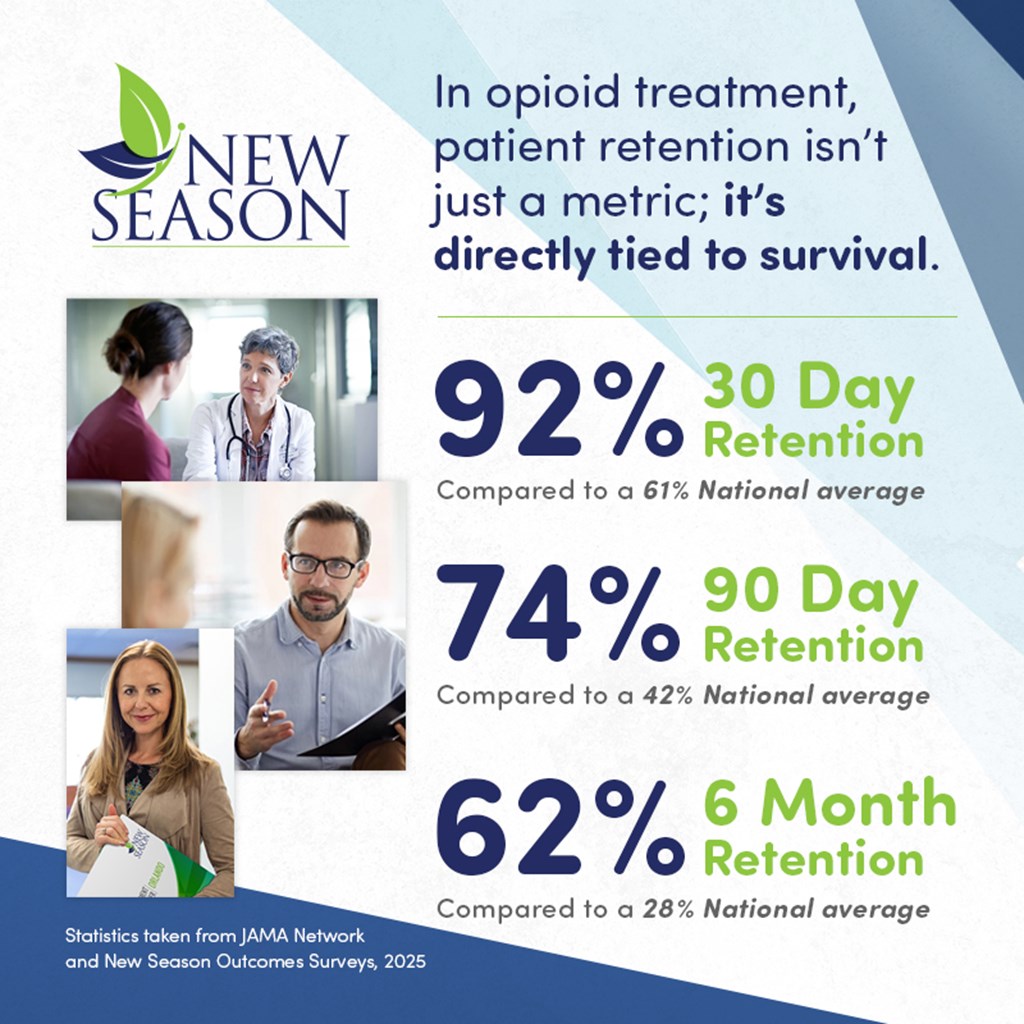
A newly published study in JAMA Network Open examining Opioid Treatment Program (OTP) retention rates across the U.S. delivers an important – and sobering – message: too many patients are not staying in treatment long enough to achieve the best possible outcomes.
The study, which analyzed more than 500,000 treatment episodes across over 1,100 OTPs from 2019 to 2023, found that retention drops off quickly:
- Just over 60% of patients remain in treatment at 30 days
- Around 40% at 90 days
- Fewer than 30% at six months
These findings highlight a critical challenge for our field. Retention is not just a metric; it is closely tied to reduced overdose risk, improved stability, and long-term recovery. When patients disengage early, the consequences can be life-threatening.
“Retention is one of the most meaningful indicators we have in opioid use disorder treatment,” Jim Shaheen, CEO of New Season, said. “When patients stay engaged, their chances of long-term recovery improve significantly, and that’s what every provider should be focused on.”
We agree with the study’s core conclusion: there is significant opportunity to improve retention across OTPs, and measuring outcomes more consistently can help move the field forward.
A Critical Question: What’s Driving Better Outcomes?
While the study underscores the problem, it also points to something equally important: not all OTPs perform the same.
The researchers found wide variation between programs, differences that could not be explained by patient complexity alone. That means outcomes are influenced not just by who is treated, but how care is delivered.
This distinction matters.
Because it suggests that improving retention is not only necessary, it is achievable.
What We’re Seeing at New Season
At New Season, we closely track patient engagement and retention because we know how essential it is to recovery. While methodologies may differ from those used in national studies, our internal data reflects a markedly different trend:
| Retention Milestone | Industry Median | New Season |
| 30 Days | 61% | 92% |
| 90 Days | 42% | 74% |
| 6 Months | 28% | 62% |
These outcomes represent more than strong performance; they reflect sustained patient engagement during the most critical phases of treatment, when the risk of relapse and overdose is highest.
“These outcomes demonstrate what’s possible when care is consistent, compassionate, and designed around the patient,” Shaheen said. “We believe every individual deserves the opportunity to stay in treatment long enough to truly stabilize and recover.”
👉 Want to learn more about how patient-centered approaches can improve retention? Explore how New Season supports individuals throughout every stage of recovery: click here.
Why Retention Improves: A Focus on Patient-Centered Care
Retention does not happen by chance. It is the result of intentional, consistent care delivery that meets patients where they are.
While every patient’s journey is different, several factors are essential to keeping individuals engaged in treatment:
- Accessible, consistent care environments that reduce barriers to daily participation
- Strong therapeutic relationships between patients and clinical teams
- Comprehensive support services, including counseling and care coordination
- Structured yet flexible treatment models that adapt to patient needs over time
“Patients facing opioid use disorder are often navigating complex clinical and social challenges at the same time,” Jessica Matthews, the senior vice president of operations at New Season, said. “Improving retention means addressing the whole person—not just the diagnosis—and ensuring care is accessible, supportive, and responsive to their needs.”
Treating opioid use disorder is complex. Many patients face co-occurring mental health conditions, unstable housing, or other social challenges. Retention improves when care models recognize and respond to that complexity.
Moving the Conversation Forward
The study and accompanying commentary call for greater transparency and standardized quality measurement across OTPs, similar to other areas of healthcare.
We welcome this conversation.
As the field evolves, it is important that:
- Measures account for the complexity of the populations served
- Data is used to support improvement, not just comparison
- High-performing models are studied and scaled
Most importantly, the conversation should remain focused on what matters most: helping more patients stay in treatment and achieve lasting recovery.
What This Means for the Future
The findings in this study are an important reminder that retention remains one of the biggest challenges – and opportunities – in opioid treatment today.
But they also reinforce something we see every day:
Better outcomes are possible.
By continuing to invest in patient-centered care, evidence-based practices, and continuous improvement, we can raise the standard of care across the industry and ensure more individuals get the support they need, for as long as they need it.
Take the Next Step
If you or someone you know is seeking treatment for opioid use disorder, staying engaged in care can make all the difference.
New Season is committed to providing accessible, evidence-based treatment that supports long-term recovery.
Find a New Season treatment center near you or learn more about our approach to care today.


